We explore
Solar system
Let’s journey through the Solar System to discover the movements, planets, and forces that shape our cosmic neighborhood, with science explained simply and clearly
★★★★★ 4.9/5
The Solar System? Piece of cake!
— About us
/01
From clouds of dust and gas to the formation of the Sun, and the delicate balance that shaped the planets
Around 4.6 billion years ago, a massive cloud filled with various elements gave rise to the Solar System. This cloud contained hydrogen, helium, and remnants from ancient supernovae. The elements began to contract, causing pressure and temperature at the core of this cloud to soar dramatically, which led to the formation of a protostar—the birth of the Sun. Meanwhile, leftover material swirled around the newborn Sun, gradually coming together to form the planets. Eventually, these components assembled into what we now know as the Solar System. Today, it keeps moving through space, with each planet orbiting around the Sun on its endless journey.
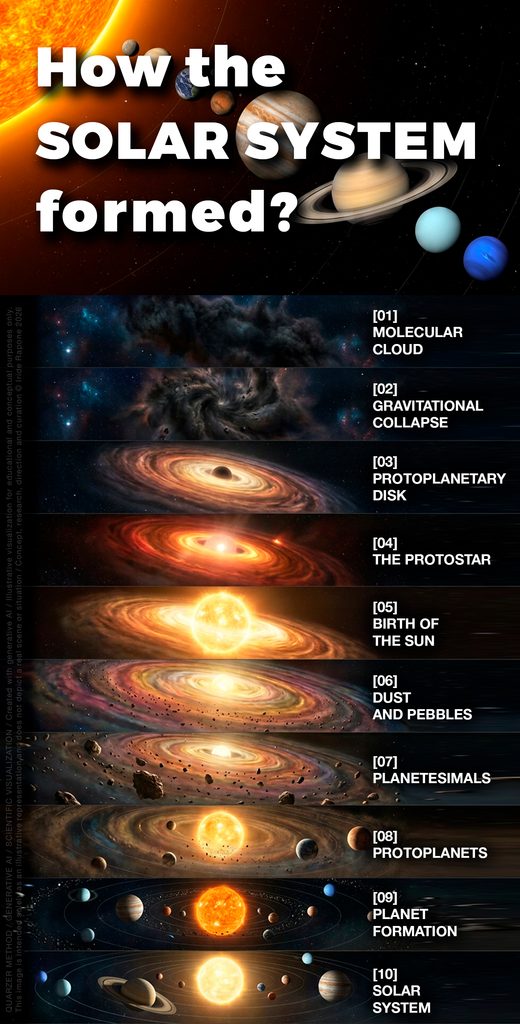
[01] The Molecular Cloud
It all begins in the vastness of space, where a gigantic cloud of gas and dust drifts through the freezing darkness, dense with mystery and potential.
[02] Gravitational Collapse
Then, the balance is broken. Gravity pulls the cloud inward, drawing its material toward the center and causing it to spin faster and faster.
[03] The Protoplanetary Disk
Driven by this rapid rotation, the cloud flattens into a wide, spinning disk. At its center, matter continues to gather and become increasingly concentrated.
[04] The Protostar
At the heart of this swirling cloud, a protostar begins to take shape. It is the first spark: pressure and temperature begin to rise dramatically.
[05] The Birth of the Sun
The core becomes an immense furnace. Once the critical temperature is reached, nuclear fusion ignites — and our Sun is born.
[06] Dust and Pebbles
Meanwhile, within the disk surrounding the newborn star, a chaotic dance begins. Dust particles collide and stick together, gradually forming grains and small rocky bodies.
[07] Planetesimals
The process continues. Through collisions and the force of gravity, these small fragments grow into planetesimals — solid building blocks of rock and ice orbiting the young Sun.
[08] Protoplanets
The planetesimals continue to collide and merge, giving rise to protoplanets — the embryos of the worlds that will eventually form.
[09] Planet Formation
The system gradually takes shape. In the regions closest to the Sun, where temperatures are higher, rocky planets begin to form, including Earth. Farther out, where it is much colder, gas and ice giants begin to take shape.
[10] Solar System
Over millions of years, the orbits clear and stabilize. The remaining debris is swept away or gathered into asteroid belts and comets, leaving behind the balanced and orderly planetary system we call home today.
Gravitational Balance and Orbital Harmony
Once formed, the planets do not simply drift through space on their own; they are locked in a delicate cosmic dance governed by the force of gravity. As they travel along their paths around the Sun, every planet exerts a gravitational pull on the others. While gravity is strictly an attractive force rather than a repulsive one, the interplay of these mutual pulls—combined with the immense gravitational dominance of the Sun and the planets’ own forward momentum—creates a stable, finely tuned equilibrium. This constant push-and-pull prevents the planets from colliding or flying off into deep space, maintaining their distinct orbital tracks and relative spacing across the vast stretches of time.
VISUALIZING THE SOLAR SYSTEM: ORBITS AND PLANETARY ORDER
When we look at the Solar System, it may seem like a vast cosmic map: at it’s center lies the Sun, surrounded by eight planets, each occupying its own place at a different distance from our star. But the Solar System is not simply a collection of worlds arranged in space; it is a vast and constantly moving system, in which every planet is travelling along its own path and the paths followed by the planets as they travel around the Sun are called orbits. In a simplified representation, these can be shown as distinct lines extending outward from the Sun, helping us visualize the overall structure of our planetary system: starting from the Sun and moving outward, the first planet we encounter is Mercury, the closest planet to our star. Beyond it lies Venus, surrounded by an extremely dense atmosphere and known for its remarkably high surface temperatures. Next comes Earth, the third planet from the Sun. It is the world we know best and, as far as we know, the only place in the Universe where life has emerged. The fourth planet is Mars, recognizable by its reddish surface. For centuries, Mars has fascinated us and continues to be one of the main subjects in our search for signs that life may once have existed beyond Earth. After the rocky inner planets, the Solar System changes dramatically. We encounter Jupiter, the largest planet in the Solar System and a true gas giant. Its mass is greater than that of all the other planets combined. Farther out is Saturn, immediately recognizable by its spectacular system of rings, made primarily of countless particles of ice and rocky material. The sequence continues with Uranus, an ice giant with an extraordinary axial tilt. Its rotation is so strongly tilted that the planet appears almost to roll along its orbit. Finally, at the outermost position among the eight planets, we reach Neptune, the eighth and farthest major planet from the Sun. So, now, human you can read the perfect sequence:
This sequence: Mercury, Venus, Earth, Mars, Jupiter, Saturn, Uranus, and Neptune represents the order of the planets according to their average distance from the Sun.
Of course, reality is far more complex than any diagram can show. Planetary orbits are not perfect circles, and the distances between worlds are immense. The planets do not travel through space in a straight line or in formation; each follows its own orbit, primarily governed by the gravitational influence of the Sun and, to a lesser extent, by the other bodies in the Solar System.
A representation like this therefore does not attempt to reproduce every detail of our planetary system. Instead, it gives us a mental map — a simple way to understand the order of the planets and visualize the broad architecture of our cosmic neighborhood.
And when we look at this sequence, we begin to appreciate something truly remarkable: the Solar System is not a collection of motionless worlds, but a vast cosmic system in perpetual motion, shaped and governed by the laws of gravity.

Hey, little astronaut! 🚀
Are you ready to explore the Solar System in motion?!
CLICK THE LINK below “EXPLORE THE SOLAR SYSTEM” and let the journey begin!
— portfolio
/02
A selection of brand films, campaigns, and documentaries — each one built around a story worth telling.

A great brand film doesn’t explain your company. It makes people feel what it’s like to believe in it.

[01] The Molecular Cloud
It all begins in the vastness of space, where a gigantic cloud of gas and dust drifts through the freezing darkness, dense with mystery and potential.
[02] Gravitational Collapse
Then, the balance is broken. Gravity pulls the cloud inward, drawing its material toward the center and causing it to spin faster and faster.
Driven by this rapid rotation, the cloud flattens into a wide, spinning disk. At its center, matter continues to gather and become increasingly concentrated.
[03] The Protoplanetary Disk
[04] The Protostar
At the heart of this swirling cloud, a protostar begins to take shape. It is the first spark: pressure and temperature begin to rise dramatically.
[05] The Birth of the Sun
The core becomes an immense furnace. Once the critical temperature is reached, nuclear fusion ignites — and our Sun is born.
[06] Dust and Pebbles
Meanwhile, within the disk surrounding the newborn star, a chaotic dance begins. Dust particles collide and stick together, gradually forming grains and small rocky bodies.
[07] Planetesimals
The process continues. Through collisions and the force of gravity, these small fragments grow into planetesimals — solid building blocks of rock and ice orbiting the young Sun.
[08] Protoplanets
The planetesimals continue to collide and merge, giving rise to protoplanets — the embryos of the worlds that will eventually form.
[09] Planet Formation
The system gradually takes shape. In the regions closest to the Sun, where temperatures are higher, rocky planets begin to form, including Earth. Farther out, where it is much colder, gas and ice giants begin to take shape.
SUN
MERCURY
VENUS
— services
/03
We cover every stage of production — from the first creative conversation to the final exported frame.
A cinematic declaration of who you are and why it matters. We develop the concept, direct the shoot, and deliver a film that works as a hero asset across your website, investor decks, and paid media. Every brand film comes with a full cutdown suite — 60s, 30s, 15s, 6s — so one production fuels your entire content ecosystem.
Built for moments that need to land hard and fast. We produce campaign films for product launches, seasonal pushes, and media-worthy activations — engineered for performance across TV, OOH, paid social, and digital display. One production budget, a full asset suite, consistent across every touchpoint.
For brands with a story too big for a single film. We produce short-form documentary series — typically 3 to 6 episodes — that build audience over time and establish genuine authority. We handle everything: research, multi-location production, edit, grade, and platform delivery.
If you have footage, we can make it broadcast-ready. Our editors, colourists, and sound designers have finished work for streaming platforms, international broadcasters, and global campaigns. We also provide motion graphics and title design for films that need a stronger visual identity.
— Process
/04
Great production isn’t accidental. It’s designed.
A clear process is the first creative decision we make. It keeps projects on time, keeps clients informed, and keeps our crew focused on what matters — capturing the story, not managing the chaos.
Discover
1
We start by understanding your audience, your message, and the emotional response you want to trigger. Every great film begins with a great brief.
Script & Storyboard
2
We develop the narrative arc, scripted or documentary-style, and map out every shot before the camera rolls. No surprises on set.
Production
3
Our crew captures your story with precision and presence — whether that’s a single-day studio shoot or a multi-country documentary expedition.
Post & Delivery
4
We edit, grade, mix, and deliver broadcast-ready files across every format and platform you need. Timelines are clear, revisions are structured.
Contact us
5
Every great film starts with a single conversation. Tell us what you’re building and we’ll tell you what’s possible.
— Our team
/05
A small, senior crew who’ve spent years getting better at one thing — telling stories that stick.
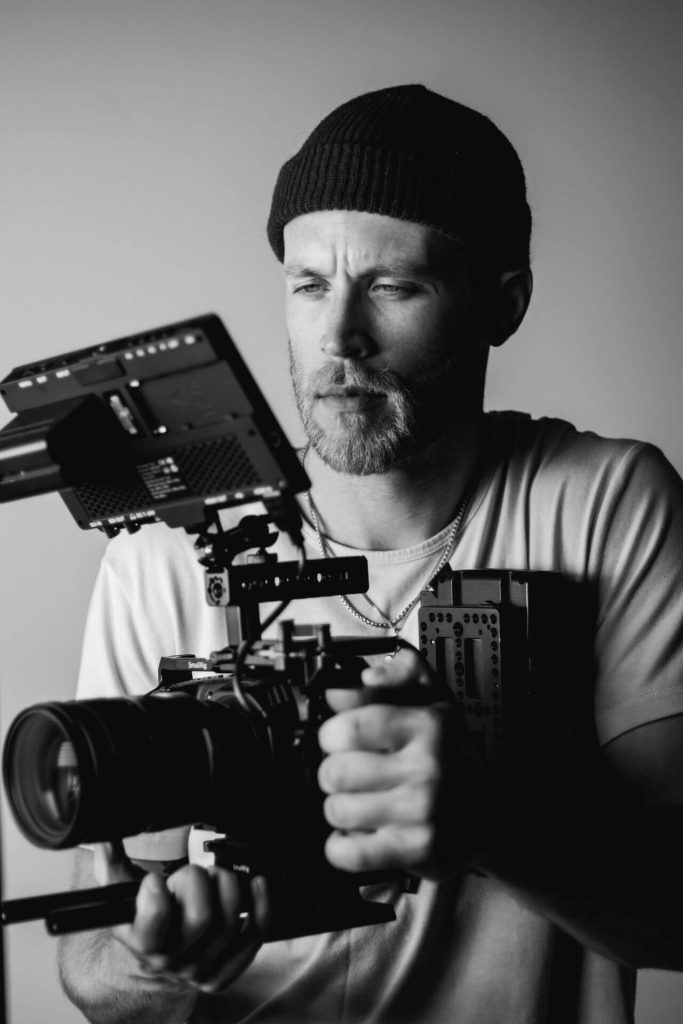
Marco den Hartog
Founder & Director
Marco has directed over 200 brand films across Europe. He started in documentary, and it shows — every frame is built around a human truth.

Lena Vasquez
Executive Producer
Lena keeps the wheels turning without letting them show. She’s managed productions across 14 countries and has never missed a delivery date.

Daan Hoekstra
Director of Photography
Daan has shot campaigns for global brands and intimate social stories. His eye for available light is why clients keep asking him back.
— testimonials
/06
Words from the people we’ve made films for.
★★★★★
4.5/5
“We briefed them on a Monday. By Friday, we had a rough cut that made our CEO cry. In a good way.”

Emma V.
Head of Brand, Aurum
★★★★★
5/5
“Every agency promised us a great film. Inspiro is the only one that delivered one.”

Jonas F.
Co-founder, Dwell
★★★★★
4.8/5
“We’ve worked with bigger studios and spent more money. Nothing has ever performed like the film Inspiro made us.”

Ren T.
VP Marketing, Fieldwork
— Why us
/07
We show up, we listen, and we deliver — every time.

The director who hears your brief is the same person who calls cut on set and approves the final grade. No handoffs, no lost context, no creative drift between departments.

Every production includes a hero film plus a complete cutdown suite — 60s, 30s, 15s, and 6s. One shoot day, one budget, everything you need to show up consistently across every channel.

Our sprint model takes most brand films from confirmed brief to final delivery in 21 days. Fast because we’re organised, structured, and have done this enough times to know exactly where projects lose time.

We cap ourselves at six active projects at any one time. Every frame that leaves this studio has been seen, questioned, and approved by a senior director — because attention is the one thing we refuse to spread too thin.
— Blog
/08
Thinking out loud on brand storytelling, production craft, and what actually makes a film work.
-

Why Your Brand Needs a New Story.
This is some dummy copy. You’re not really supposed to read this dummy copy, it is just a placeholder for people who need some type to visualize what the actual copy might look like if it were real content. If you want to read, I might suggest a good book, perhaps Melville. That’s why they call it, the dummy copy. This, of course, is not the real copy for this…


— Start a project
/09
Let’s make something!
+31 10 000 0000
hello@inspiro.com