We explore
Periodic table
Let’s journey through the Periodic Table to discover the elements, bonds, and reactions that shape our chemical world, with science explained simply and clearly
★★★★★ 4.9/5
“The Periodic Table? Easy peasy!”
From simple gas and basic elements to the formation of complex matter, creating the systematic table that catalogs every element on Planet Earth
In 1869 Dmitri Mendeleev arranged the then-known chemical elements into a new system on the basis of their properties and atomic weights. By placing them in a repeating pattern he showed there was an underlying order in matter and even included spaces for elements which had not yet been discovered. As time went on the discovery of new elements and scientific advances turned his system into the modern Periodic Table, which is now one of the basic tools in chemistry.

Hey, little chemist! 🧪
Are you ready to step into the secrets of the periodic table?!
VISUALIZING THE PERIODIC TABLE: GROUPS AND CHEMICAL ORDER
At glance the Periodic Table may look like a simple grid of symbols.. If you take a closer look you can see that its structure is not random; It tells a story about how atoms are built and how they behave. The table is arranged into 18 columns, known as groups and 7 horizontal rows, called periods, each element has its place based on the number of protons in its nucleus and how its electrons are organized around that nucleus.
The way elements are grouped together helps us understand why some behave similarly: on the left side of the table we find the Alkali Metals. These include lithium, sodium, potassium and others and they are very reactive with water and tend to lose one electron easily to form positive ions.
Next to them are the Alkaline Earth Metals. This group includes beryllium, magnesium, calcium and others; they are also reactive, but not quite as much as the metals; still they readily give up two electrons when forming compounds.
In the middle of the table there’s a section called the Transition Metals. This includes iron, copper, silver, gold, zinc and many others; these elements are important because they have properties like high conductivity, malleability and strength. That’s why they play such a role in building homes, cars, tools and electronics and their ability to form compounds makes them useful in art and industry too.
Moving to the side of the table we reach the Metalloids. These are elements like boron, silicon, germanium, arsenic, antimony and tellurium, they don’t fit neatly into either the metal or nonmetal category. Instead they have characteristics, silicon, for example, is a material in computer chips and solar panels due to its semiconducting behavior.
Further to the right we find the Halogens. This group includes fluorine, chlorine, bromine, iodine and astatine. All of them are reactive nonmetals, they want one electron to complete their outer shell so they often bond with metals to create salts. You’ll find chlorine in bleach and pool cleaners while fluorine is used in toothpaste.
Finally at the right we have the Noble Gases. These are helium, neon, argon, krypton, xenon and radon. Their outer electron shells are full which means they are stable and rarely react with elements because of this they’re often used in lighting—neon signs for instance—and in atmospheres for welding or scientific experiments.
Below the body of the table there are two rows that are usually shown separately, these are the Lanthanides and the Actinides. The lanthanides, sometimes called rare-earth elements include elements like cerium, neodymium and europium. Many of these are vital in technology—like strong magnets in headphones and wind turbines or phosphors in screens.
The actinides contain elements like uranium and plutonium. Most of them are radioactive. Only exist in trace amounts naturally or are made in labs, some are used in nuclear power plants and weapons though their handling requires care.
All of these groups and series come together to make up what we call the Periodic Table; this layout is not accidental! Every position reflects patterns in nature—how atoms hold their electrons how they share or transfer them and how that leads to predictable chemical behaviors.
Course atoms are far more complex than what a single box on a chart can show. What we see in the table is a simplification—a way to organize information… Behind each symbol lies a world of quantum rules, energy levels and interactions between particles. Elements don’t just sit quietly in their spots; they connect with one another forming bonds, creating molecules, building minerals and shaping the materials we use every day.
So the Periodic Table is not a list of symbols. It’s a map of matter. It shows us how things work at the level… When we study it more deeply we begin to appreciate how orderly and interconnected the natural world really is—from the tiniest atoms to the largest structures humans create. The Periodic Table gives us a framework to understand the chemistry of everything, around us.
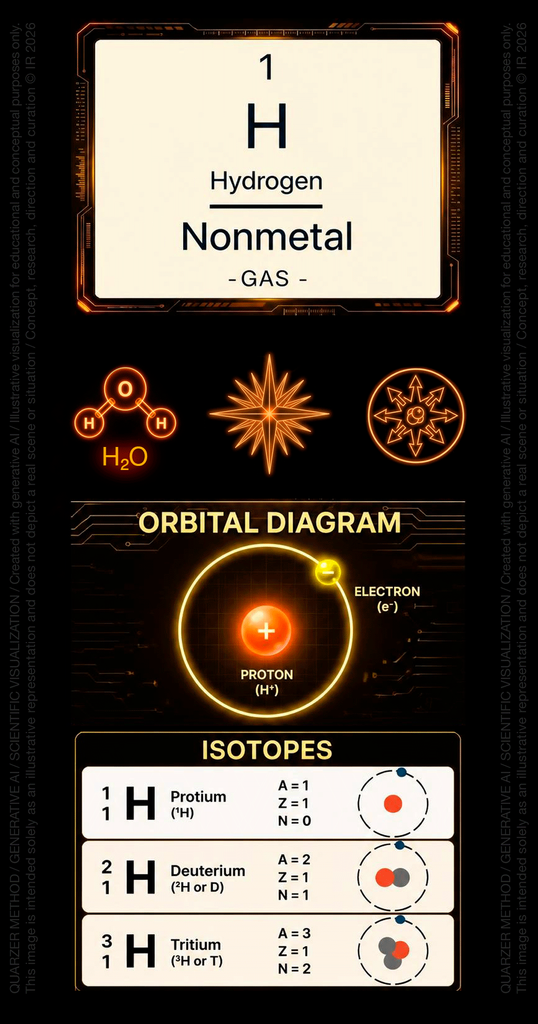
[01] HYDROGEN
H
SYMBOL: H
ATOMIC NUMBER: 1
CATEGORY: Nonmetal
STATE AT ROOM TEMPERATURE: Gas
MOST COMMON ISOTOPE: Protium (¹H)
EARLY OBSERVATION: Paracelsus, early 1500s
DISCOVERY AS A DISTINCT SUBSTANCE: Henry Cavendish, 1766
NAME: Antoine Lavoisier
KEY PROPERTY: Highly flammable
MAIN STELLAR ROLE: Nuclear-fusion fuel
The simplest atom
Hydrogen is the lightest and most abundant element in the Universe; its atom contains just one proton and, when electrically neutral, one electron. Hydrogen is also the main component of stars, where nuclear fusion converts hydrogen into helium and releases enormous amounts of energy.
ISOTOPES
When people talk about protium, deuterium, and tritium, they’re referring to the three naturally occurring isotopes of hydrogen.
Think of isotopes as slightly different “versions” of the exact same element in effect, every hydrogen atom has 1 proton and 1 electron (that’s what makes it hydrogen), but they can have different numbers of neutrons packed into the nucleus. That extra weight doesn’t really change how they react chemically, but it gives them unique physical traits.
Here’s how they break down:
Protium (¹H): This is your standard, everyday hydrogen—making up about 99.98% of all hydrogen on Earth. Its nucleus has 1 proton and 0 neutrons. Simple as it gets.
Deuterium (²H): Often called “heavy hydrogen,” it makes up a tiny fraction (about 0.015%) of natural hydrogen. Its nucleus holds 1 proton and 1 neutron. When paired with oxygen, it forms heavy water, which is widely used in nuclear reactors.
Tritium (³H): This one is radioactive and super rare in nature, found only in trace amounts. Its nucleus packs 1 proton and 2 neutrons. Because it decays over time, it’s used in self-powering glow-in-the-dark tech (like watch hands) and is a key fuel candidate for future nuclear fusion reactors.
Transition temperatures
Boiling point: -252.87 °C (20.28 K)
Melting point: -259.16 °C (13.99 K)
Triple point: -259.35 °C (at 7.04 kPa)
Critical point: -239.96 °C at 1.29 MPa
Combustion & flammability
Autoignition temperature 500 °C – 570 °C
Flammability range 4% – 75% in air (extremely wide)
Ignition energy 0.02 mJ (a tiny spark is enough to ignite it)
Flame Nearly invisible in daylight (UV emission)
Key Properties
Gas density 0.0899 g/L (14 times lighter than air)
Thermal conductivity 0.182 W/(m·K) (highest among gases)
Specific heat capacity 14.3 kJ/(kg.K)
Hydrogen embrittlement Penetrates metal structures, making them brittle
Metallic hydrogen Becomes a conductor under extreme pressure (> 400 GPa)
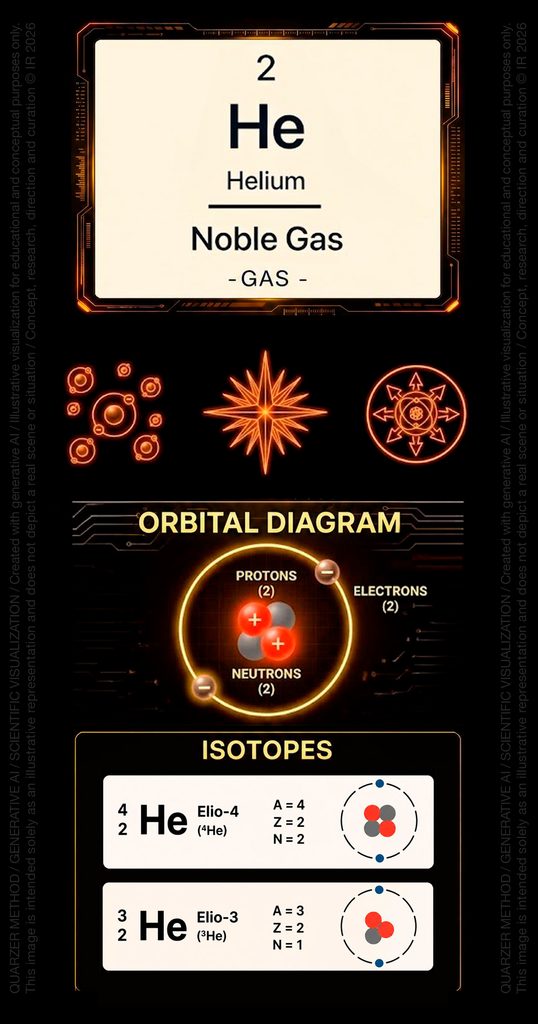
[02] HELIUM
He
SYMBOL: He
ATOMIC NUMBER: 2
CATEGORY: Nonmetal (Noble Gas)
STATE AT ROOM TEMPERATURE: Gas
MOST COMMON ISOTOPE: Helium-4 (⁴He)
EARLY OBSERVATION: Pierre Janssen & Norman Lockyer, 1868
DISCOVERY AS A DISTINCT SUBSTANCE: William Ramsay, 1895
NAME: Norman Lockyer (from Greek Helios, the Sun)
KEY PROPERTY: Chemically inert and non-flammable
MAIN STELLAR ROLE: Product of hydrogen fusion in stars
The simplest atom
Helium is the second lightest and second most abundant element in the Universe; its atom contains two protons, two neutrons, and, when electrically neutral, two electrons. Helium is completely chemically inert, remaining a gas at almost all temperatures, and was first detected in the Sun’s spectrum before being found on Earth.
ISOTOPES
When people talk about helium-4 and helium-3, they’re referring to the two naturally occurring isotopes of helium.
Think of isotopes as slightly different “versions” of the exact same element—every helium atom has 2 protons and 2 electrons (that’s what makes it helium), but they can have different numbers of neutrons packed into the nucleus. That extra weight doesn’t change its non-reactive nature, but it creates vastly different physical behavior at extreme low temperatures.
Here’s how they break down:
Helium-4 (⁴He): This is your standard, everyday helium—making up over 99.999% of all helium on Earth. Its nucleus contains 2 protons and 2 neutrons. It becomes a superfluid (flowing without friction) near absolute zero.
Helium-3 (³He): An extremely rare isotope on Earth (about 0.000137%), containing 2 protons and only 1 neutron. It is prized for quantum physics research, ultra-low temperature cooling, and as a potential clean fuel for future nuclear fusion reactors.
Transition temperatures
Transition temperatures
Boiling point: -268.93 °C (4.22 K)
Melting point: -272.20 °C (0.95 K) at 2.5 MPa pressure
Triple point: None (Helium does not freeze at atmospheric pressure)
Critical point: -267.96 °C at 0.227 MPa
Combustion & flammability
Autoignition temperature: N/A (Non-flammable)
Flammability range: Non-flammable in air
Ignition energy: N/A
Flame: None (Inert gas)
Key Properties
Gas density: 0.0001785 g/cm³ (0.1785 g/L, 7 times lighter than air)
Thermal conductivity: 0.1513 W/(m·K)
Specific heat capacity: 5.19 kJ/(kg·K)
Electron configuration: 1s²
Ionization energy: 24.587 eV (highest of all elements)
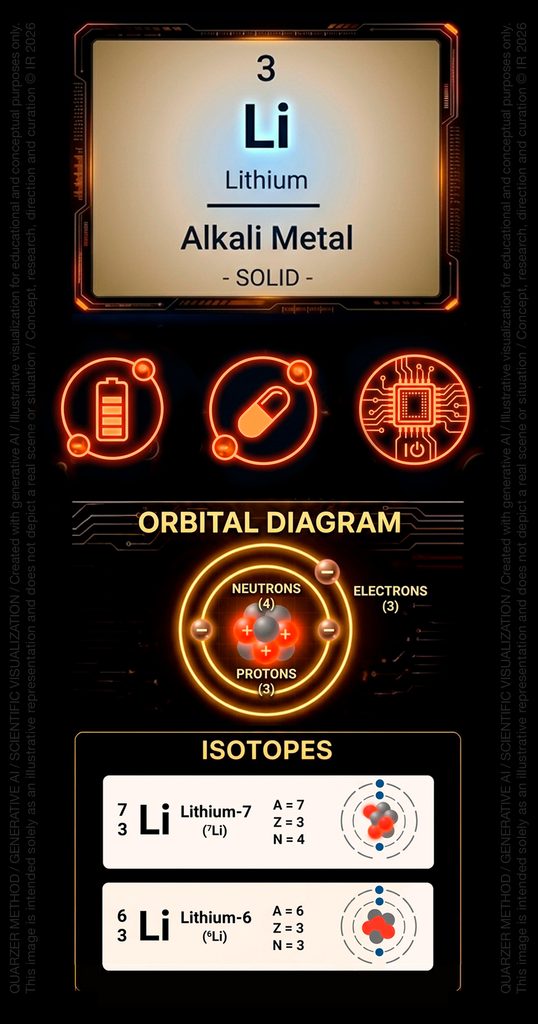
[03] LITHIUM
Li
SYMBOL: Li
ATOMIC NUMBER: 3
CATEGORY: Alkali Metal
STATE AT ROOM TEMPERATURE: Solid
MOST COMMON ISOTOPE: Lithium-7 (⁷Li)
EARLY OBSERVATION: Johan August Arfwedson, 1817
DISCOVERY AS A DISTINCT SUBSTANCE: Johan August Arfwedson, 1817
NAME: Jöns Jacob Berzelius (from Greek lithos, stone)
KEY PROPERTY: Lightest metal and highly reactive
MAIN STELLAR ROLE: Produced in primordial nucleosynthesis and destroyed in stellar cores
The lightest solid element
Lithium is the lightest of all metals and the least dense solid element at room temperature; its atom contains three protons, four neutrons (in its most common form), and three electrons. Highly reactive and soft enough to be cut with a butter knife, lithium floats on water while reacting vigorously with it and is widely used today in energy storage technologies.
ISOTOPES
When people talk about lithium-7 and lithium-6, they’re referring to the two naturally occurring, stable isotopes of lithium.
Think of isotopes as slightly different “versions” of the exact same element—every lithium atom has 3 protons and 3 electrons (that’s what makes it lithium), but they can have different numbers of neutrons packed into the nucleus. While chemically identical, their different nuclear properties make them crucial for nuclear technologies and batteries.
Here’s how they break down:
Lithium-7 (⁷Li): This is your standard, everyday lithium—making up about 92.41% of all lithium on Earth. Its nucleus contains 3 protons and 4 neutrons. It is widely used as a coolant additive in nuclear reactors and as a primary component in commercial lithium-ion batteries.
Lithium-6 (⁶Li): A rarer stable isotope, making up about 7.59% of natural lithium, containing 3 protons and 3 neutrons. It is essential in nuclear physics for breeding tritium (a key fuel for nuclear fusion) when bombarded with neutrons.
Transition temperatures
Boiling point: 1342 °C (1615 K)
Melting point: 180.50 °C (453.65 K)
Triple point: 180.50 °C at 10⁻⁵ Pa
Critical point: 2950 °C at 67 MPa
Combustion & flammability
Autoignition temperature: ~179 °C in air
Flammability range: Highly reactive solid (reacts exothermically with moisture and air)
Ignition energy: Low (spontaneously ignites at molten temperatures or in contact with water)
Flame: Brilliant crimson / bright pinkish-red
Key Properties
Solid density: 0.534 g/cm³ (about half as dense as water)
Thermal conductivity: 84.8 W/(m·K)
Specific heat capacity: 3.58 kJ/(kg·K) (highest of all solid elements)
Electron configuration: [He] 2s¹
Electronegativity: 0.98 (Pauling scale)
Ionization energy: 5.392 eV (520.2 kJ/mol)

[01] The Molecular Cloud
It all begins in the vastness of space, where a gigantic cloud of gas and dust drifts through the freezing darkness, dense with mystery and potential.
[02] Gravitational Collapse
Then, the balance is broken. Gravity pulls the cloud inward, drawing its material toward the center and causing it to spin faster and faster.
[03] The Protoplanetary Disk
Driven by this rapid rotation, the cloud flattens into a wide, spinning disk. At its center, matter continues to gather and become increasingly concentrated.
[04] The Protostar
At the heart of this swirling cloud, a protostar begins to take shape. It is the first spark: pressure and temperature begin to rise dramatically.
[05] The Birth of the Sun
The core becomes an immense furnace. Once the critical temperature is reached, nuclear fusion ignites — and our Sun is born.
[06] Dust and Pebbles
Meanwhile, within the disk surrounding the newborn star, a chaotic dance begins. Dust particles collide and stick together, gradually forming grains and small rocky bodies.
[07] Planetesimals
The process continues. Through collisions and the force of gravity, these small fragments grow into planetesimals — solid building blocks of rock and ice orbiting the young Sun.
[08] Protoplanets
The planetesimals continue to collide and merge, giving rise to protoplanets — the embryos of the worlds that will eventually form.
[09] Planet Formation
The system gradually takes shape. In the regions closest to the Sun, where temperatures are higher, rocky planets begin to form, including Earth. Farther out, where it is much colder, gas and ice giants begin to take shape.
[10] Solar System
Over millions of years, the orbits clear and stabilize. The remaining debris is swept away or gathered into asteroid belts and comets, leaving behind the balanced and orderly planetary system we call home today.
Gravitational Balance and Orbital Harmony
Once formed, the planets do not simply drift through space on their own; they are locked in a delicate cosmic dance governed by the force of gravity. As they travel along their paths around the Sun, every planet exerts a gravitational pull on the others. While gravity is strictly an attractive force rather than a repulsive one, the interplay of these mutual pulls—combined with the immense gravitational dominance of the Sun and the planets’ own forward momentum—creates a stable, finely tuned equilibrium. This constant push-and-pull prevents the planets from colliding or flying off into deep space, maintaining their distinct orbital tracks and relative spacing across the vast stretches of time.

CLICK on an element to discover how many protons make up its atom!
— portfolio
/02
A selection of brand films, campaigns, and documentaries — each one built around a story worth telling.


A great brand film doesn’t explain your company. It makes people feel what it’s like to believe in it.

[01] The Molecular Cloud
It all begins in the vastness of space, where a gigantic cloud of gas and dust drifts through the freezing darkness, dense with mystery and potential.
[02] Gravitational Collapse
Then, the balance is broken. Gravity pulls the cloud inward, drawing its material toward the center and causing it to spin faster and faster.
Driven by this rapid rotation, the cloud flattens into a wide, spinning disk. At its center, matter continues to gather and become increasingly concentrated.
[03] The Protoplanetary Disk
[04] The Protostar
At the heart of this swirling cloud, a protostar begins to take shape. It is the first spark: pressure and temperature begin to rise dramatically.
[05] The Birth of the Sun
The core becomes an immense furnace. Once the critical temperature is reached, nuclear fusion ignites — and our Sun is born.
[06] Dust and Pebbles
Meanwhile, within the disk surrounding the newborn star, a chaotic dance begins. Dust particles collide and stick together, gradually forming grains and small rocky bodies.
[07] Planetesimals
The process continues. Through collisions and the force of gravity, these small fragments grow into planetesimals — solid building blocks of rock and ice orbiting the young Sun.
[08] Protoplanets
The planetesimals continue to collide and merge, giving rise to protoplanets — the embryos of the worlds that will eventually form.
[09] Planet Formation
The system gradually takes shape. In the regions closest to the Sun, where temperatures are higher, rocky planets begin to form, including Earth. Farther out, where it is much colder, gas and ice giants begin to take shape.

SUN
MERCURY
VENUS
— services
/03
We cover every stage of production — from the first creative conversation to the final exported frame.
A cinematic declaration of who you are and why it matters. We develop the concept, direct the shoot, and deliver a film that works as a hero asset across your website, investor decks, and paid media. Every brand film comes with a full cutdown suite — 60s, 30s, 15s, 6s — so one production fuels your entire content ecosystem.
Built for moments that need to land hard and fast. We produce campaign films for product launches, seasonal pushes, and media-worthy activations — engineered for performance across TV, OOH, paid social, and digital display. One production budget, a full asset suite, consistent across every touchpoint.
For brands with a story too big for a single film. We produce short-form documentary series — typically 3 to 6 episodes — that build audience over time and establish genuine authority. We handle everything: research, multi-location production, edit, grade, and platform delivery.
If you have footage, we can make it broadcast-ready. Our editors, colourists, and sound designers have finished work for streaming platforms, international broadcasters, and global campaigns. We also provide motion graphics and title design for films that need a stronger visual identity.
— Process
/04
Great production isn’t accidental. It’s designed.
A clear process is the first creative decision we make. It keeps projects on time, keeps clients informed, and keeps our crew focused on what matters — capturing the story, not managing the chaos.
Discover
1
We start by understanding your audience, your message, and the emotional response you want to trigger. Every great film begins with a great brief.
Script & Storyboard
2
We develop the narrative arc, scripted or documentary-style, and map out every shot before the camera rolls. No surprises on set.
Production
3
Our crew captures your story with precision and presence — whether that’s a single-day studio shoot or a multi-country documentary expedition.
Post & Delivery
4
We edit, grade, mix, and deliver broadcast-ready files across every format and platform you need. Timelines are clear, revisions are structured.
Contact us
5
Every great film starts with a single conversation. Tell us what you’re building and we’ll tell you what’s possible.
— Our team
/05
A small, senior crew who’ve spent years getting better at one thing — telling stories that stick.

Marco den Hartog
Founder & Director
Marco has directed over 200 brand films across Europe. He started in documentary, and it shows — every frame is built around a human truth.

Lena Vasquez
Executive Producer
Lena keeps the wheels turning without letting them show. She’s managed productions across 14 countries and has never missed a delivery date.

Daan Hoekstra
Director of Photography
Daan has shot campaigns for global brands and intimate social stories. His eye for available light is why clients keep asking him back.
— testimonials
/06
Words from the people we’ve made films for.
★★★★★
4.5/5
“We briefed them on a Monday. By Friday, we had a rough cut that made our CEO cry. In a good way.”

Emma V.
Head of Brand, Aurum
★★★★★
5/5
“Every agency promised us a great film. Inspiro is the only one that delivered one.”

Jonas F.
Co-founder, Dwell
★★★★★
4.8/5
“We’ve worked with bigger studios and spent more money. Nothing has ever performed like the film Inspiro made us.”

Ren T.
VP Marketing, Fieldwork
— Why us
/07
We show up, we listen, and we deliver — every time.

The director who hears your brief is the same person who calls cut on set and approves the final grade. No handoffs, no lost context, no creative drift between departments.

Every production includes a hero film plus a complete cutdown suite — 60s, 30s, 15s, and 6s. One shoot day, one budget, everything you need to show up consistently across every channel.

Our sprint model takes most brand films from confirmed brief to final delivery in 21 days. Fast because we’re organised, structured, and have done this enough times to know exactly where projects lose time.

We cap ourselves at six active projects at any one time. Every frame that leaves this studio has been seen, questioned, and approved by a senior director — because attention is the one thing we refuse to spread too thin.
— Blog
/08
Thinking out loud on brand storytelling, production craft, and what actually makes a film work.
-

Why Your Brand Needs a New Story.
This is some dummy copy. You’re not really supposed to read this dummy copy, it is just a placeholder for people who need some type to visualize what the actual copy might look like if it were real content. If you want to read, I might suggest a good book, perhaps Melville. That’s why they call it, the dummy copy. This, of course, is not the real copy for this…


— Start a project
/09
Let’s make something!
+31 10 000 0000
hello@inspiro.com