
-

The STAR that makes life possible on EARTH
The Sun is a medium-sized star belonging to the main sequence; it is the most massive body in the Solar System, containing approximately 99.8% of its total mass. The Sun was born about 4.6 billion years ago from the gravitational collapse of a gigantic cloud of gas and dust called the solar nebula and the matter concentrated at the center gave rise to our star, while the remaining material formed planets, moons, asteroids, and other celestial bodies.
CLASSIFICATION
Type: Main-sequence star
Spectral class: G2V (yellow dwarf)
Age: Approximately 4.6 billion years old
Location: Center of the Solar System
DIMENSIONS
Diameter: ~1,392,700 km
Radius: ~696,340 km
Mass: ~333,000 Earth masses
Volume: ~1.3 million Earths
MASS & GRAVITY
Mass: ~1.989 × 10³⁰ kg (≈333,000 Earths)
Surface gravity: ~274 m/s² (≈28× Earth’s gravity)
Gravitational influence: Holds 99.8% of the Solar System’s total mass
COMPOSITION
State: Entirely plasma (no solid surface)
Hydrogen: ~73.5%
Helium: ~24.9%
Other elements: ~1.6%
TEMPERATURE
Core: ~15 million °C (~27 million °F)
Photosphere: ~5,500 °C (~9,930 °F)
Chromosphere: ~4,500–25,000 °C (~8,130–45,030 °F)
Corona: up to ~2 million °C (~3.6 million °F)
STRUCTURE
State: Entirely plasma (no solid surface)
Hydrogen: ~73.5%
Helium: ~24.9%
Other elements: ~1.6%
ROTATION
Rotation period (equator): ~25 days
Rotation period (poles): ~36 days
Rotation type (plasma): Differential
Axis tilt: ~7.25°
Direction: Counterclockwise
Rotation axis: North–South
SOLAR MOTION
Solar Apex: Toward Hercules
Relative speed: ~13–20 km/s
Galactic oscillation: Through the galactic plane
Bound system: Entire Solar System
Heliosphere: Travels with the Sun
Motion type: Galactic
GALACTIC ORBIT
Orbits: Milky Way center
Galactic region: Orion Spur
Distance from center: ~26,000 light-years
Orbital period: ~230 million years
Orbital speed: ~720,000 km/h (200 km/s)
Orbit shape: Nearly circular
DISTANCE FROM EARTH
Average distance: ~149.6 million km (1 AU)
Light travel time: ~8 minutes 20 seconds
Distance range: ~147.1–152.1 million km
SOLAR SYSTEM POSITION
Role: Solar System’s central star
Bodies: Planets, dwarf planets, asteroids & comets
System mass: ~99.8% of total mass
COSMIC LOCATION
Galaxy: Milky Way Galaxy
Galactic region: Orion Spur (local arm)
Distance from Galactic Center: ~26,000 light-years

[01] Photosphere visible surface
[02] Sunspots cooler, darker regions
[03] Granulation convection cells on the surface
[04] Chromosphere layer above the photosphere
[05] Prominences arcs of plasma above the surface
[06] Solar Flares powerful bursts of energy
[07] Coronal Mass Ejections (CMEs) massive plasma eruptions
[08] Corona Sun’s outer atmosphere
[09] Solar Wind charged particles flowing into space
[10] Coronal Holes darker, cooler regions of the corona
[11] Magnetic Field drives much of the Sun’s activity
[12] Solar Cycle ~11-year cycle of activity
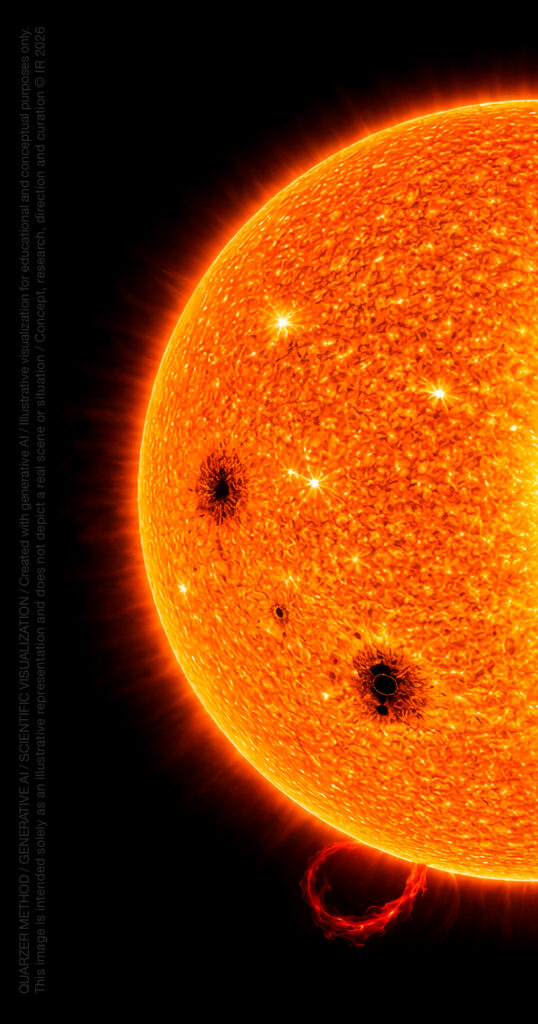
[01] Photosphere visible surface
[02] Sunspots — cooler, darker regions
[03] Granulation — convection cells on the surface
[04] Chromosphere — layer above the photosphere
[05] Prominences — arcs of plasma above the surface
[06] Solar Flares — powerful bursts of energy
[07] Coronal Mass Ejections (CMEs) — massive plasma eruptions
[08] Corona — Sun’s outer atmosphere
[09] Solar Wind — charged particles flowing into space
[10] Coronal Holes — darker, cooler regions of the corona
[11] Magnetic Field — drives much of the Sun’s activity
[12] Solar Cycle — ~11-year cycle of solar activity
Interactive 3D visualization provided by NASA Eyes; source: NASA Jet Propulsion Laboratory (JPL), California Institute of Technology.
DEEP
CLASSIFICATION
Type: Main-sequence star
Spectral class: G2V (yellow dwarf)
Age: Approximately 4.6 billion years old
Location: Center of the Solar System
DIMENSIONS
Diameter: Approximately 1,392,700 km
Radius: Approximately 696,340 km
Mass: 333,000 times that of Earth
Volume: Could contain approximately 1.3 million Earths

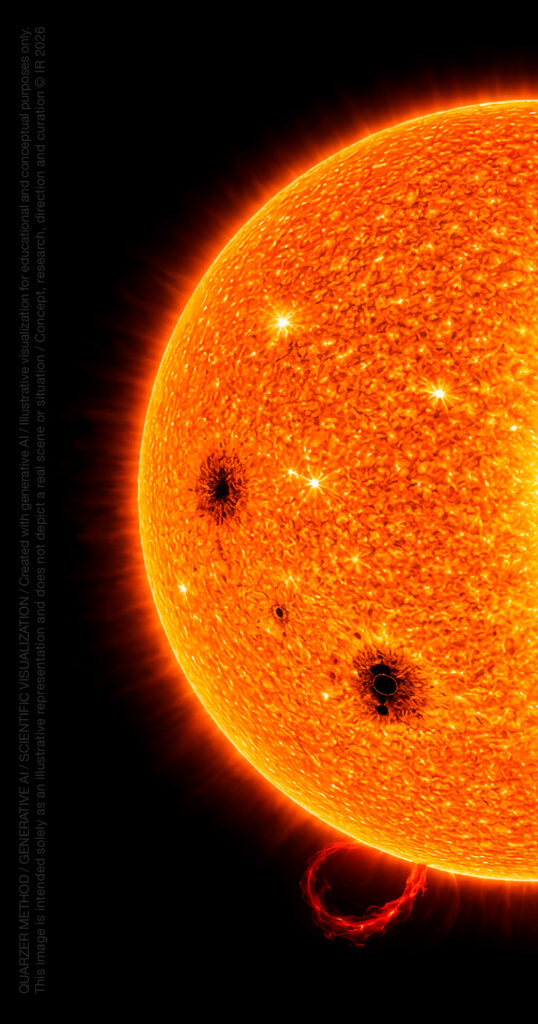
[01] Photosphere -> visible surface
[02] Sunspots -> cooler, darker regions
[03] Granulation -> convection cells on the surface
[04] Chromosphere -> layer above the photosphere
[05] Prominences -> arcs of plasma above the surface
[06] Solar Flares -> powerful bursts of energy
[07] Coronal Mass Ejections (CMEs) -> massive plasma eruptions
[08] Corona -> Sun’s outer atmosphere
[09] Solar Wind -> charged particles flowing into space
[10] Coronal Holes -> darker, cooler regions of the corona
[11] Magnetic Field -> drives much of the activity
[12] Solar Cycle -> ~11-year cycle of activity
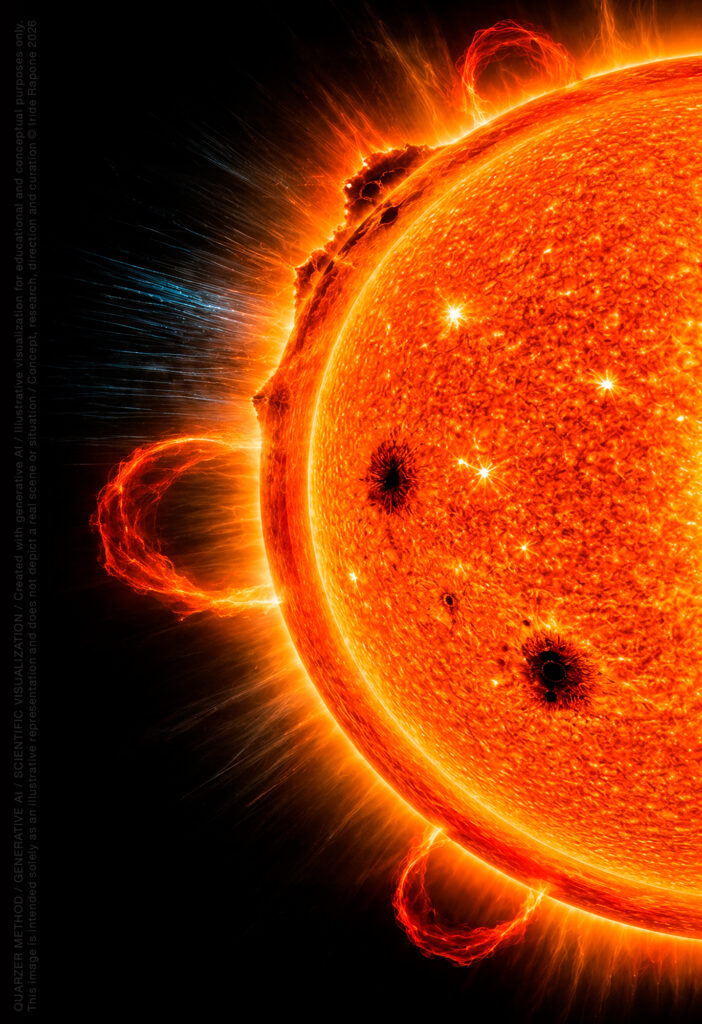
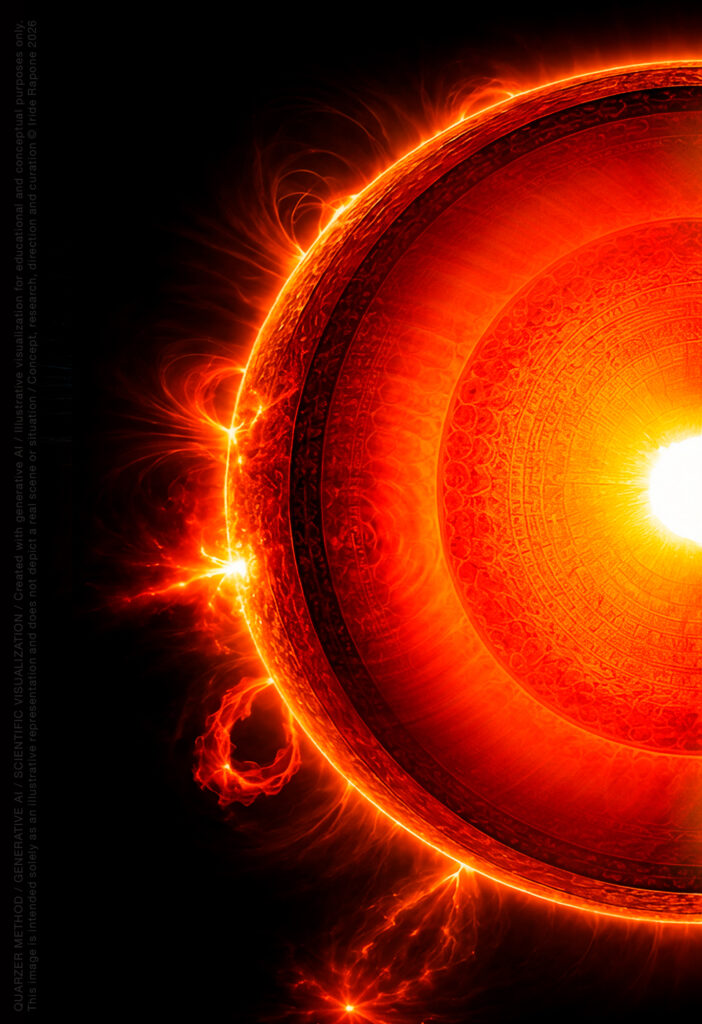
[01] Photosphere -> visible surface
[02] Sunspots -> cooler, darker regions
[03] Granulation -> convection cells on the surface
[04] Chromosphere -> layer above the photosphere
[05] Prominences -> arcs of plasma above the surface
[06] Solar Flares -> powerful bursts of energy
[07] Coronal Mass Ejections (CMEs) -> massive plasma eruptions
[08] Corona -> Sun’s outer atmosphere
[09] Solar Wind -> charged particles flowing into space
[10] Coronal Holes -> darker, cooler regions of the corona
[11] Magnetic Field -> drives much of the activity
[12] Solar Cycle -> ~11-year cycle of activity
— Start a project
/09
Let’s make something!
+31 10 000 0000
hello@inspiro.com